Michel van der Aa / Works / 

Theory of Flames

Menu button

Newsletter


Dark Light

In this new film opera, Theory of Flames, Michel van der Aa examines one of the most urgent questions of our time: how do we process information in an era when truth becomes increasingly elusive? The opera arrives at a crucial moment, as disinformation has become a daily reality, and influential figures reach millions of people through social media with conspiracy theories and disinformation.

Theory of Flames translates this societal challenge into a personal story. The opera poses fundamental questions: How do we maintain meaningful relationships with people whose reality radically differs from our own? What happens when facts become a matter of belief rather than evidence? Do we have the right to choose our own version of truth, even if it separates us from those we love?  

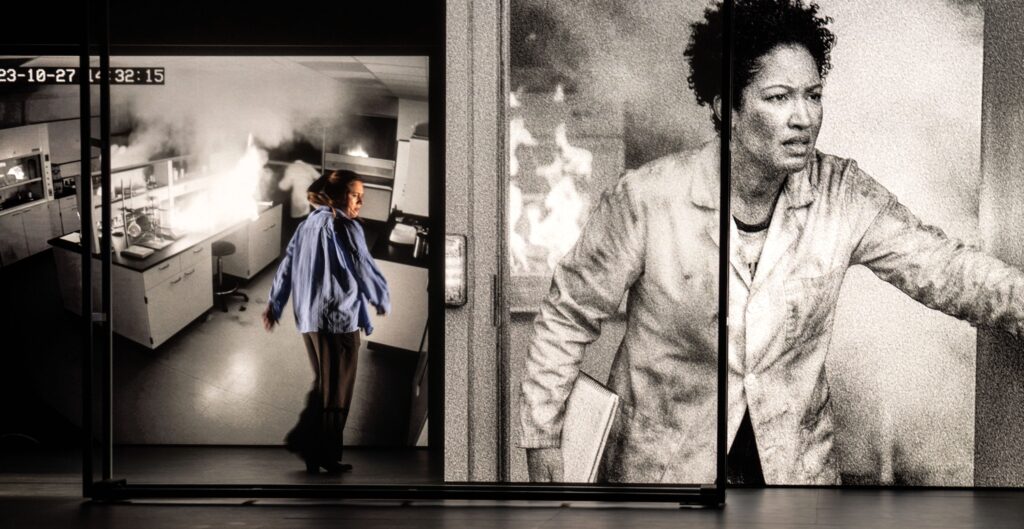
At the center of this work is Neola, a director creating a science fiction film about a research project that ended in a devastating laboratory fire. As she investigates further, her research leads her down unexpected paths where alternative explanations begin to reshape her perspective. Her growing obsession with these discoveries creates distance between her and those closest to her – partner Marianne and friend Josh – who struggle to understand her changing worldview.

“The opera explores how differing perceptions of truth can create profound barriers between people who care deeply for one another,” explains Van der Aa. “It asks us to consider what happens when our fundamental understanding of reality no longer aligns with those we love.”

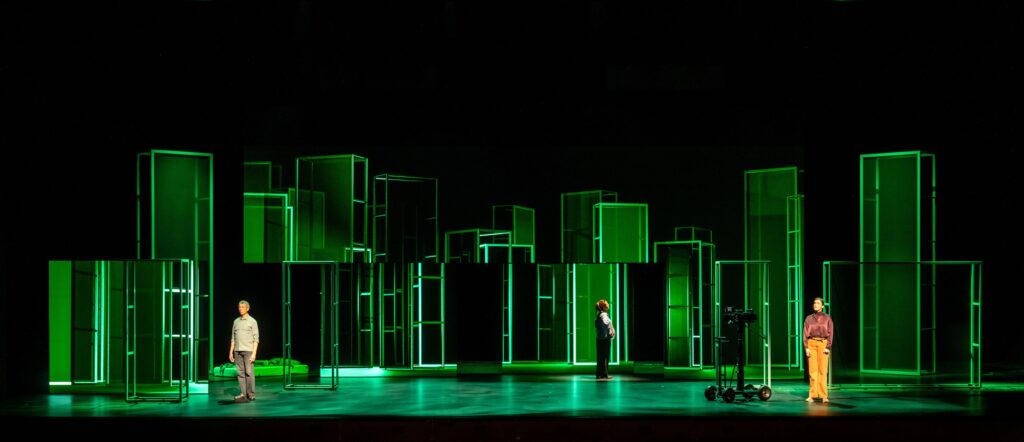
In this world premiere, film and stage design blend seamlessly, challenging audiences to reflect on what is real and what is not. Soprano Mary Bevan and mezzo-soprano Helen Charlston make their house debuts as Neola and her partner Marianne. Baritone Roderick Williams returns to Dutch National Opera, this time as cameraman Josh, while soprano Julia Bullock appears in the film footage. The Residentie Orkest performs under conductor Elena Schwarz, with the Dutch National Opera chorus featured in the film segments. The creative team also includes set and lighting designer Theun Mosk and dramaturges Madelon Kooijman and Niels Nuijten.

Theory of Flames is a commission and co-production of Dutch National Opera, The Norwegian National Opera, the Bregenz Festival, and the doubleA Foundation.

The world premiere of the opera took place at Dutch National Opera on March 6, 2026. The opera will tour internationally in 2028–29.

Cast, stage
Mary Bevan, Aphrodite Patoulidou – Neola
Helen Charlston – Marianne
Roderick Williams – Josh
Julia Bullock – Scientist (on film)

Residentie Orkest, conducted by Elena Schwarz
Choir of Dutch National opera (on film), conducted by Edward Ananian-Cooper

Cast, film
Taylor Burgess, David Eeles, and Abel de Vries
Extras: Members of Choir of the National Opera

Team
Michel van der Aa – Composer, director, libretto
Elena Schwarz – Musical director
Theun Mosk – Scenography & light
Judith de Zwart – costume design
Madelon Kooijman, Niels Nuijten – Dramaturges
Joost Rietdijk – Director of Photography
Stein van de Ven, Joey Heynens – 3D design

Arjen Oosterbaan – Production Manager
Nik Tenten– Technical director
Pieter Loman – Stage Mmanager
Annemiek van Elst – Assistant director
Pepijn van der Sanden – lighting operator
Jos Dijkstra – video operator
Tom Gelissen – Sounddesign
Tomas Valečka – Sound engineer
Fergus McAlpine – Play-out operator
Merijn Versnel – Set builder
Martijn van Nunen – stage technician
Nils Pauwels – LED producer
Giso Spijkerman – VFX
Bart Voorsluis – Grading

Aram Balian (doubleA foundation) – Managing Director
Jeffrey Wiering (doubleA foundation) – Creative Producer
Reviews

Defining opera for a modern age

“By seamlessly synthesizing current political topics – fake news and conspiracy theories – with contemporary art forms, van der Aa has created a very unique opera for a modern age. […] For literary lovers, the quality of the English libretto will not go unnoticed […] The set is a feast for the eyes […]

Hugely-talented musical director Elena Schwarz, whose precision and attention to detail is van der Aa’s secret weapon […] The Residentie Orkest navigated this complex score with aplomb. By treating electronics simply as another instrument to enhance his musical vocabulary – akin to the introduction of trumpets, trombones and percussion to the modern orchestra – van der Aa appears to lead the way.

This is a production you will want to see again, and again.”
★★★★  Bachtrack

You have to see it to believe it

Everything is if possible even more impressive than in Van der Aa’s earlier works, with the difference that as a composer he is more lyrical than ever. With as highlight the stunningly beautiful trio We morph, we split, we sever.

Film and reality intertwine in a wonderful way, and once again Van der Aa has his live singers sing fantastically together with film characters.

You have to see it to believe it.
★★★★  Trouw

Grimly recognizable

Neola’s journey down a disinformation rabbit hole is grimly recognizable.  […] With its sympathy for ordinary people, its reflective arias, its moments of orchestral opulence and its dramatic through line, “Theory of Flames” begins to seem like a modern take on verismo opera in the vein of Puccini, a style based on heightened reality.

— New York Times

A magnificent mirror palace of moving film screens

Overwhelming. Astonishing. Grandiose. […]  In the extremely complicated whole, everything falls into place. A magnificent mirror palace of moving film screens. How far do you go along with Van der Aa and his characters who lose each other and themselves in an ingenious, original and confusing spectacle about conspiracies that is itself already an extremely clever conspiracy?

The music sounds beautiful, the Residentie Orchestra plays very beautifully under conductor Elena Schwarz, the members of the Dutch National Opera Choir are in fine form in their filmed state in the background, the soloists are excellent. But above all: in the extremely complicated whole, everything falls into place.

— Theaterkrant

Powerful work

A short (1h35) but powerful work in which the audience is constantly confronted with boundaries: between modern classical music (a remarkably orchestrated score, conducted with finesse by Elena Schwarz) and electronic music, between live voices and pre-recorded singing, between three-dimensional characters (on stage) and two-dimensional ones (in the film).

A spectacular yet at the same time engaging production, with excellent singers.

— La Libre Belgique

Dazzling multimedia spectacle

Theory of Flames is a further step in the connection between opera and technology that characterizes Van der Aa — a film opera in five scenes that is also a dazzling multimedia spectacle.

— Ópera Actual

A sensation

Served by an exceptional cast, chorus, and orchestra conducted with rigor and mastery by Elena Schwarz, the latest film-opera by the Dutch composer—who also wrote the libretto and directed the staging—creates a sensation at the Opera Forward Festival. With Theory of Flames, composer and director Michel van der Aa delivers a multifaceted work where theater, cinema, and opera complement and enrich one another.

Dense from the opening scene, the music is particularly eclectic, successively or simultaneously incorporating electronics, delicate strings, winds and brass in abrupt chords, and elements borrowed from rock. In the pit, conductor Elena Schwarz at the helm of the Residentie Orkest masterfully handles the complex direction of this singular total opera, rightfully acclaimed by the audience.

— Diapason Magazine

With enormous perfection, film and stage, electronic display and live music merge into a unified whole.

Briljant libretto […]  The distinctive instrumentation is certainly given its due throughout, yet is frequently supplemented by pre-produced sounds and at times almost completely withdrawn. The fact that the stylistic shifts associated with this do not lead to any ruptures, but rather are situated within a musical continuum and flow into one another or influence each other almost imperceptibly, testifies to Van der Aa’s great craftsmanship: the beats of electronic dance music thus become just as natural a component of his musical language as those moments of reflective pause in which the composer pays homage to the arias of the traditional opera genre.

That the evening remains in lasting memory, however, is not only connected to the concept of the film opera and the high-quality performance, but is also thanks to the shift in perspective that Van der Aa executes at the end of the opera to pull the rug out from under the audience’s feet.

— NMZ, Neue Musik Zeitung

The haunted house of contemporary humanity

As if Jan Dibbets cut up a peacock into a collage, that’s how geometrically colorful Theory of Flames sounds. The orchestral score is a strictly linear acoustic floor plan of lines and planes, filled with a chaos of samples from creamy analog synthesizers and keyboard instruments from the old days. The sounding input of the Residentie Orkest under Elena Schwarz becomes a motorized system of dramaturgically controlled movement. That skeleton becomes round and lush after the composer’s electronic final editing, in a style you immediately recognize as his own. Half Mondrian, half fluid slide, paradoxically cool-sensual in warm neon light. The voices are a liquid binding and contrasting agent, in the flesh or lifelike via the screens that everywhere in Theory of Flames disruptively mirror or contradict the physical reality on stage.

From Michel van der Aa you’re accustomed to disruption, after all he is composer and filmmaker and director. But this time his multimedia image and sound mixture manifests itself as the anatomy of a crisis in the field of perception, recognizable to everyone. The intention is not that you find the key to interpretation, but that you let the confusion wash over you with full force. Theory of Flames is the haunted house of contemporary humanity who no longer knows where they are, for whom the parallel reality of the virtual world has already merged with the real one.

— De Groene

Can you still believe your eyes?

Stagecraft transitions into film in a cunning manner. The finale of Theory of Flames is music theatre with a golden edge. This moving scene is quintessentially Van der Aa […] A beautiful ethereal, twelve-member choir. […] In terms of visuals, Theory of Flames is brilliant. Can you still believe your eyes? That is precisely the question that touches on the theme.

— De Volkskrant

A flagship production

The formula is one that has made Van der Aa’s music theater famous: a refined interplay between live performance and recorded images, interwoven with truly impressive technical mastery. The intricate plot aside, what works best in this new work—which questions what is real and what is fake, an extremely timely theme in an era dominated by war propaganda and media manipulation—is not so much the plot itself as the complex interplay between recorded images and stage action.

The overall realization is impeccable, entrusted to a group of performers perfectly integrated into the show’s sophisticated technological mechanism. The clever contraption devised by Van der Aa ultimately captures the attention of the audience, who follow the show with engagement and at the end offer heartfelt applause to all the performers. This is a confirmation of the Dutch composer’s unusual skill in constructing stage devices of great fascination, even when narrative and verbal complexity risk dimming their theatrical power.

— Il Giornale della Musica

A work of great imaginative force and immediate accessibility

The multimedia elements are not merely decorative, but an essential component: video projections, electronic soundscapes, 3D film, live footage, and virtual reality function as additional “instruments” that expand van der Aa’s musical vocabulary

The duet Open Your Eyes Softly Now, the trio Humming Always Seeing, the arioso I See Who You Really Are — in which the recorded voices of the chorus blend with Marianne’s singing — Josh’s arioso One Hole in the Net, and the opera’s finale, in which Marianne duets with Neola’s recorded voice against a background of organ cluster chords, are all moments of great musical power.

The production as a whole is thoroughly engaging, and the use of technological media borders on the virtuosic. The fusion of two genres — opera and film — apparently similar but in reality entirely different, is remarkably well achieved: van der Aa, who wrote both the libretto and the film screenplay, directs both the opera and the film, creating a work of great imaginative force and immediate accessibility.

The performance was received with great enthusiasm, and the composer and all the performers were warmly celebrated for a thoroughly successful work — one capable of naturally fusing different artistic languages into a coherent and involving theatrical experience.

— OperaClick

Successful hybridisation

The “double” ace up the sleeve of this tenth edition was Theory of Flames, a daring and complex interdisciplinary proposal.

The technical virtuosity of an undeniably immersive production was striking, concatenating recorded footage and live scenes while clearly delineating the intricate game of narrative matryoshkas in which realities intertwine.

Van der Aa’s new opera represents another successful hybridisation, well received both for its format and its technical and artistic quality.

While not innovative—since many elements were already present in some form in Van der Aa’s previous works—it does consolidate the opening toward new ways of telling a story on stage, something important in a genre as hermetic and even historically conservative as opera. Regardless of audience tastes and opinions, it is undeniably positive that contemporary opera addresses both social and scientific themes to bring variety to libretti.

— Platea magazine

Must see art to untangle the chaos

Theory of Flames, by Michel van der Aa, moves beyond the traditional. From the beginning, the lines between reality and illusion start to blur. Through an interactive set design combined with prerecorded film, the stage becomes a hybrid environment where the performers interact seamlessly with what appears on screen. It becomes difficult to distinguish what is physically happening on stage and what exists only on the screen.

That confusion is exactly the point.

Visually, the work unfolds almost like a painting that is constantly shifting. Layers of film, stage  design and movement interact perfectly with the performers, creating an image that is always in motion. The result is interesting, but also slightly unsettling. One line in particular stayed with us long after the performance ended: “It’s not about safety, it’s about control.” In a time where our understanding of reality is increasingly shaped by screens, the opera feels less like a spectacle and more like a quiet confrontation with how easily our sense of truth can fracture.

— Numéro

Multimedia masterpiece

Hypermodern conspiracy opera by Michel van der Aa touches […] In five scenes, an extremely gripping story unfolds. Van der Aa’s multimedia masterpiece leaves you shaken. We live in an era in which increasingly realistic AI-generated music and texts are flooding the world. It is more important than ever to stay alert and to keep looking and listening carefully. Theory of Flames holds up a mirror to us, but also makes us resilient.

— De Nieuwe Muze

Teaser

Instrumentation

Film opera
2024-2025

1 soprano
1 mezzosoprano
1 baritone

1 mezzosoprano (film)
choir, 12 voices (film)

Chamber Orchestra

Film, 4 channels
Soundtrack, surround

Details

Duration

95′

First Performance

6 March 2026
Muziektheater, Amsterdam, Netherlands

Commissioned by

Dutch National Opera, The Norwegian National Opera, the Bregenz Festival, and the doubleA Foundation.

With support of Ammodo, Gieskes-Strijbis Fonds, Simac, PixReal, Amsterdam Fund for the Arts, and Fonds podiumkunsten.

Publisher

Boosey & Hawkes

Performances

Last performance


22 March 2026

Theory of Flames

Dutch National Opera. Aphrodite Patoulidou, Helen Charlston, Roderick Williams, Julia Bullock (film). Residentie Orkest, Musical director: Elena Schwarz

Muziektheater, Amsterdam, Netherlands

All performances of Theory of Flames

News

22 February 2026

World premiere Theory of Flames

In his new film opera, Theory of Flames, Michel van der Aa examines how conspiracy theories and disinformation can threaten our human lives. The stage premiere at Dutch National Opera, opening on 6 March, will be followed by future performances at Norwegian National Opera and the Bregenz Festival. D...

Read more

1 September 2025

World premiere of new film opera “Theory of Flames”

Ticket sales have started for Michel van der Aa’s new film opera “Theory of Flames.” The opera will premiere at Dutch National Opera on 6 March 2026. You can book your tickets here. “Theory of Flames” examines one of the most urgent questions of our time: how do we process ...

Read more